I am a physics student at SRM University-AP. I build lab instruments and the
software that runs them. I am looking for a six-month research internship in quantum hardware,
from January to June 2027.
To study a material, we put a small sample in a vacuum chamber, heat it step by
step, and measure it at each temperature. Our chamber kept overshooting the temperature it was told
to reach. I found the setting that caused it, and wrote the software that now runs the whole
measurement without anyone standing next to it.
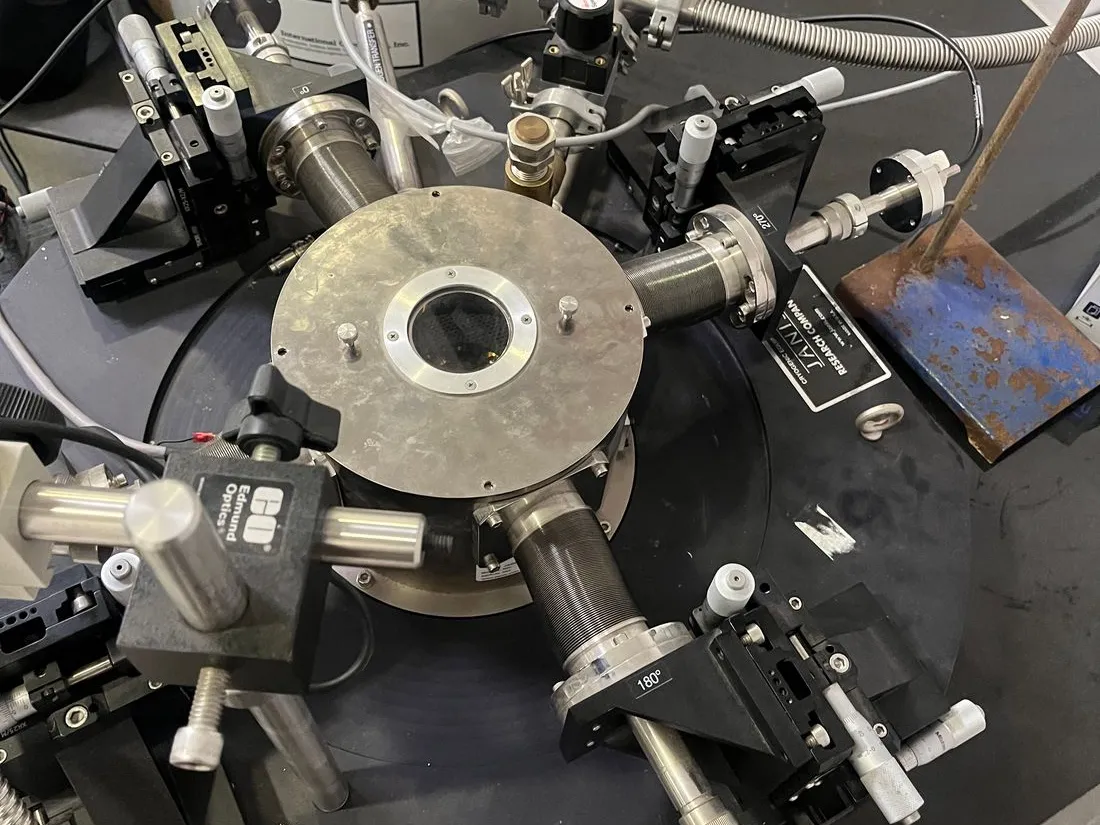
The probe station in the lab. The sample sits under the round window.
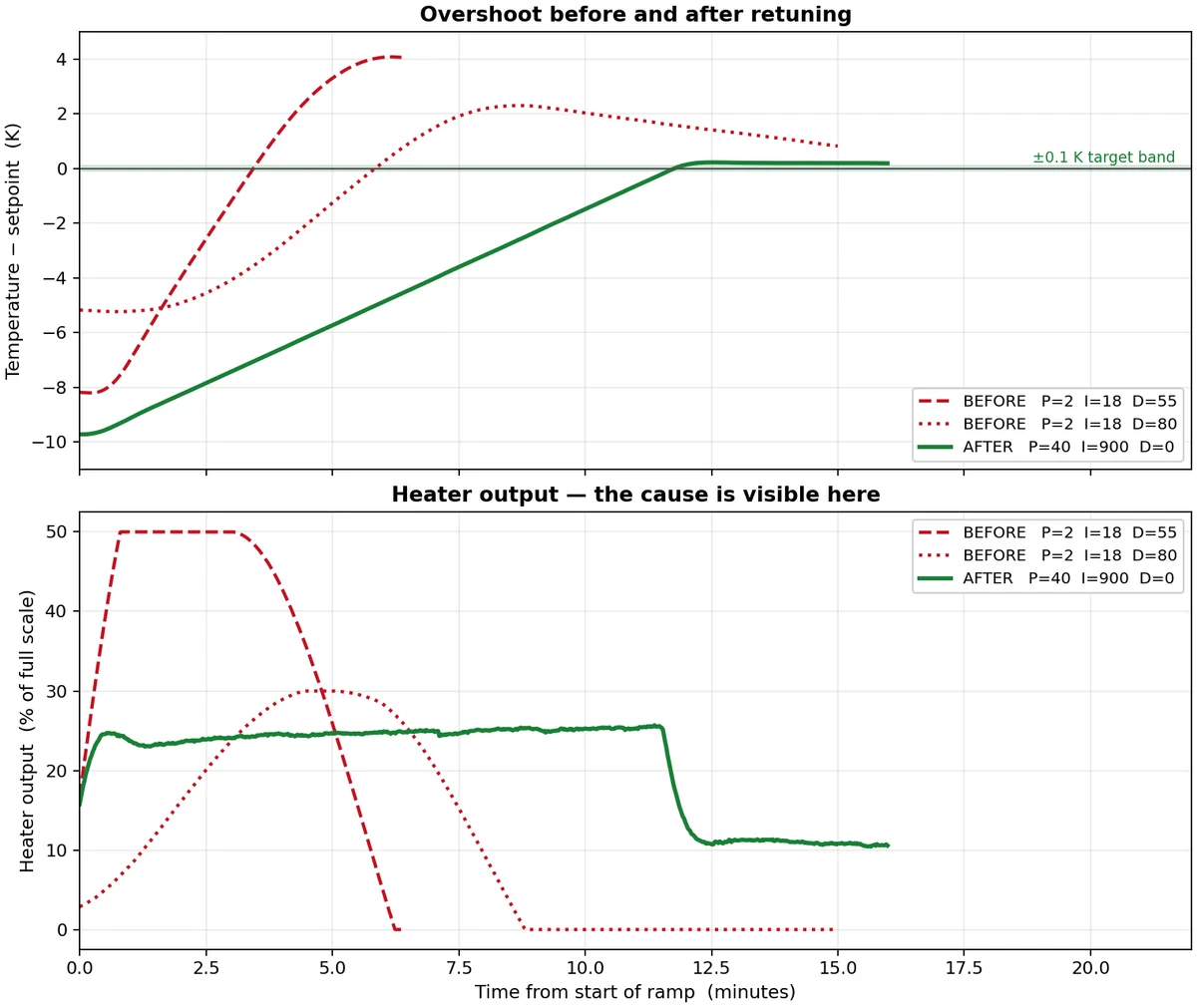
The overshoot went from about 4 K to about 0.2 K. The setup works from room temperature up to
450 K (about 177 °C). Cooling with liquid nitrogen is planned but not running yet. I did this
under my supervisor, Dr. Krishna Prasad Maity.
Technical details
Equipment: Janis ST-LN-500 probe station, Cryo-con 22C temperature controller, Wayne Kerr
6500B-series impedance analyser.
Machined an aluminium connector on a CNC, with a precision gasket, to carry electrical
connections into the vacuum (10-2 mbar).
Wrote the temperature control first in LabVIEW, then in Python: an RS-232 driver, a control
panel, and a staged ramp. A second program drives the impedance analyser over GPIB or LAN.
Together they step from 300 to 470 K in 5 K steps, wait 5 minutes within ±0.10 K, then run a
200-point sweep from 20 Hz to 10 MHz at each step. This produced the PMN-PT dataset below.
Overshoot study (5 Sep 2026): overshoot reduced from +4.08 K to +0.22 K over 297 to 450 K at
1.5 × 10⁻² mbar. The usual explanation, "heat soak", did not hold: after the heater
switched off, the temperature rose only 0.001 to 0.046 K more.
The cause was in the manual. The controller's IGAIN setting is an integral time in seconds,
not a gain, so earlier tuning had gone the wrong way. A 30% heater-power cap also made the
target unreachable. Final settings: P = 40, I = 900 s, maximum power 70%.
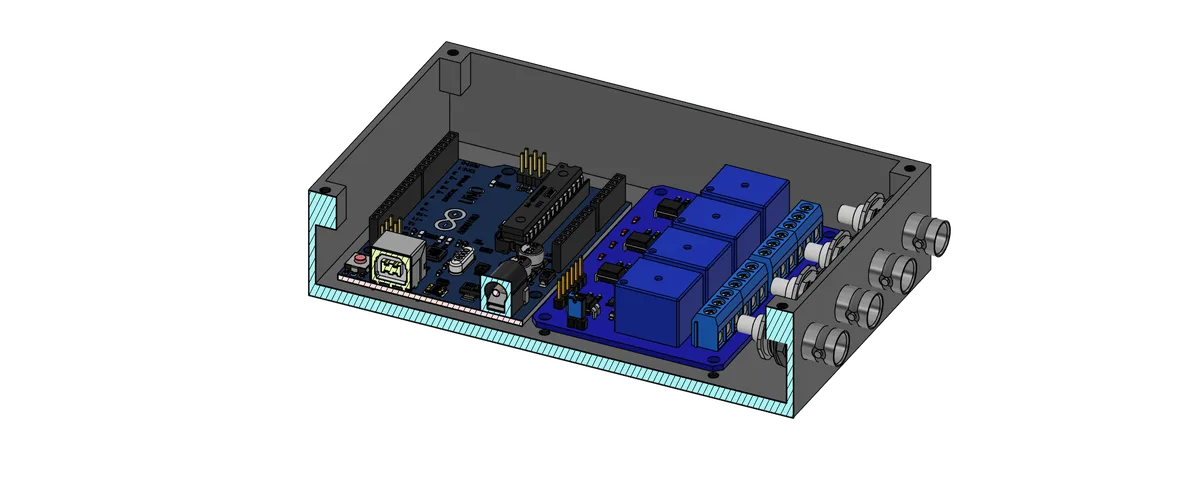
Safety cutoff: an Arduino with an optically isolated 4-channel relay board cuts the heater
at 470 K. Outputs are set to the safe state before they are enabled, so no relay clicks when
the board starts.
Before and after. Red is the old settings, green is the new ones.The relay cutoff board in its 3D-printed case (CAD model).
A light sensor made from two kinds of tiny crystals: cadmium selenide, and dots
of graphene a few nanometres wide. Mixing them made the sensor respond about ten times faster. It
works from ultraviolet, through visible light, into the near-infrared.
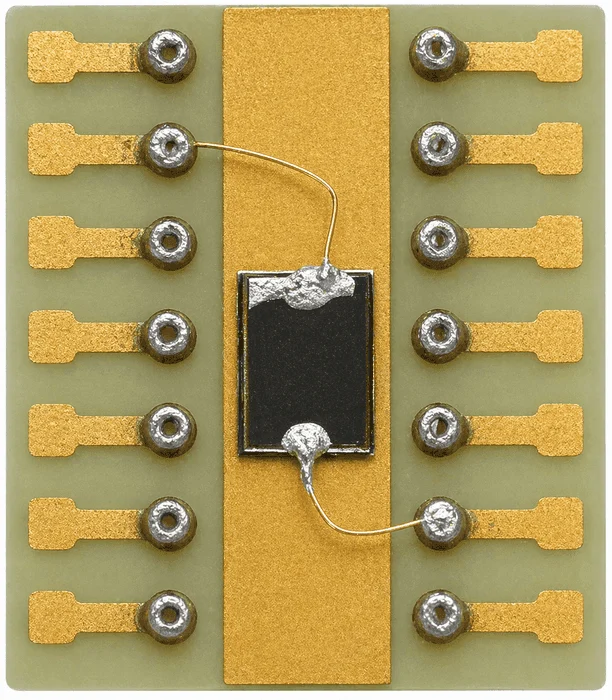
The sensor: a 5 × 5 mm silicon chip coated with the crystal mixture, with
silver-paste contacts.
I built and automated the measurement setup, measured the samples and made the figures. I worked
with Akshay Sampath and Nilja George, under Dr. Krishna Prasad Maity. Akshay and I have written a
draft paper. It has not been submitted yet.
Technical details
Hydrothermal CdSe mixed with N,S-doped graphene quantum dots (GQD) at 2:1 and 3:1, drop-cast
on silicon.
Photoresponse measured under 375, 530, 780 and 970 nm LEDs.
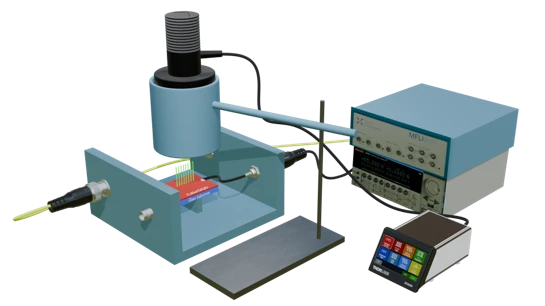
Rig automated in LabVIEW: Keithley 2636B source meter, Thorlabs DC2200 LED driver, Zurich
Instruments MFLI lock-in amplifier, OMM-6810B optical power meter.
LED power calibrated with my own Python scripts over GPIB. LED and sample holder designed
and 3D-printed, so every measurement uses the same geometry.
Results: responsivity 0.098 A/W, external quantum efficiency 32.6%, specific detectivity
1.5 × 10¹¹ Jones, linear dynamic range 14.9 dB, rise time 200 ms down to 20 ms,
lock-in tracking up to 50 Hz.
The measurement setup, drawn in Blender for the paper.
LabVIEWMFLI Lock-inKeithley SMUThorlabs LED
DriverPython3D Printing
Shakti Photon Solutions is a startup on our campus. It builds machines that make
hydrogen from water, and fuel cells that turn hydrogen back into electricity. I work there as a
production engineer. I make the parts that go inside these cells, machine the plates and housings,
and write the procedures down so that the next person can repeat them.
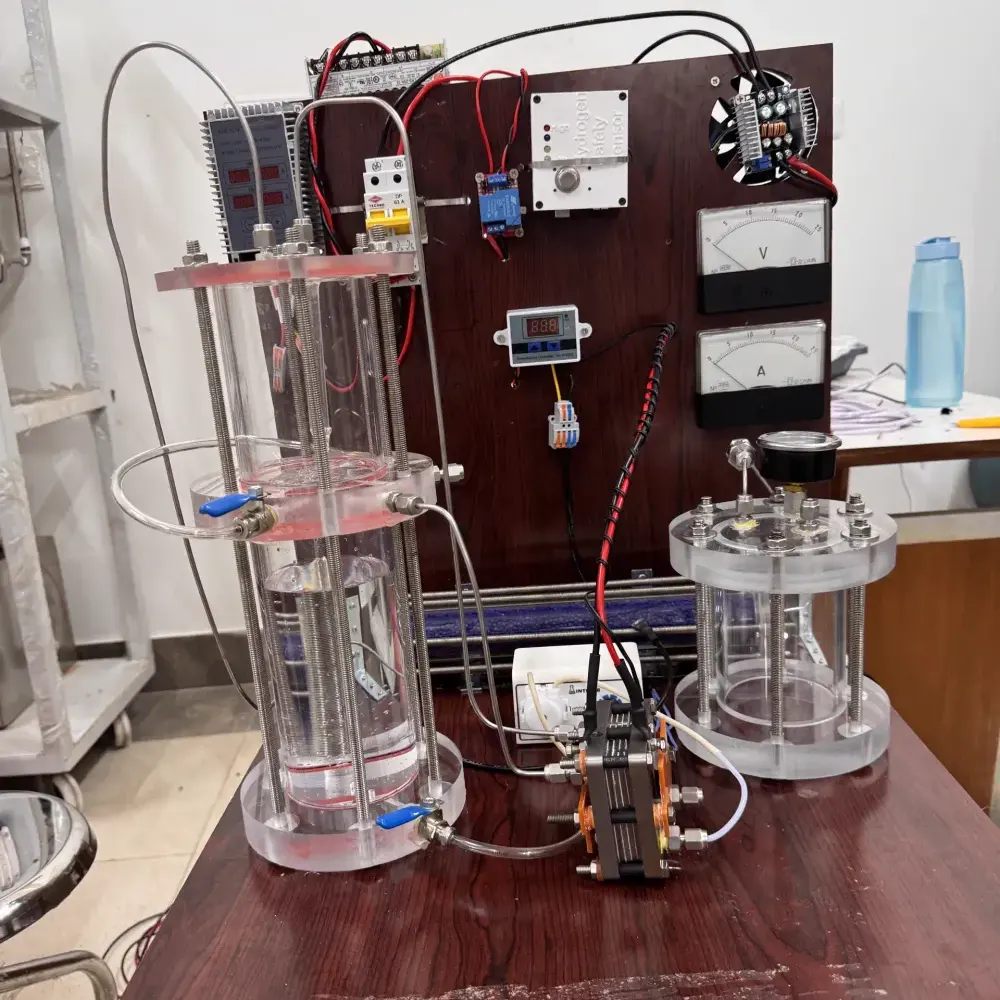
An electrolyser test bench, built with the team. The white box on the panel is the
hydrogen leak sensor I made.
My mentors there are Dr. Mallikarjuna Rao M and Noah Jacob.
Technical details
Fabricated membrane electrode assemblies (MEAs) by ultrasonic spray coating and hot pressing.
Wrote lab procedures for treating and activating PiperION anion-exchange ionomer and
membrane, and for pretreating titanium felt.
Designed parts in Fusion 360 and made them by CNC and 3D printing, in steel, graphite,
acrylic and PTFE.
Worked on the design of a 30 × 30 cm electrolyser.
Built a hydrogen leak detector with an MQ-8 sensor on Arduino, in a printed housing.
Commissioned a fuel-cell balance-of-plant system at IIT Delhi and trained the staff there.
Wrote a Python program that runs electrochemical tests (linear sweep voltammetry,
chronopotentiometry, chronoamperometry, pulse I-V) on an ITECH IT-M3902C power supply.
Code on GitHub.
With Visitha Padilam, ran a study of a barium sulphate paint for radiative cooling.
Can a magnet change how a material responds to light?
Device Physics Lab · SRM University-APUG/PG SEED Grant
↓
The university gave us a small research grant to test one idea. We took cadmium
selenide, added a little chromium to make it weakly magnetic, and measured the current it gives
under light, with and without a magnetic field.
The data is collected. There is no report or paper yet. I worked with Visitha Padilam, under
Dr. Krishna Prasad Maity.
Technical details
Samples: pristine CdSe and 3%, 5% and 7% Cr-doped CdSe (a dilute magnetic semiconductor).
I-V sweeps in the dark and under a 530 nm LED (5 to 50 mA drive), with an electromagnet at
0 to 5 A.
Calibrated the electromagnet: 0.2 to 7.8 A gives 181 to 5,260 gauss.
Recorded with the same LabVIEW rig as the light sensor above. Wrote a small Streamlit tool
to analyse the sweeps.
How a ceramic stores electric charge as it gets hotter
Device Physics Lab · SRM University-AP
↓
PMN-PT is a ceramic used in sensors and actuators. I measured how well it stores
electric charge from room temperature up to 460 K. This was the first full job for the automated
setup described above: it ran the whole measurement by itself.
Technical details
Temperature-dependent dielectric spectroscopy: 20 Hz to 10 MHz at 100 mV, 300 to 460 K, on
the probe station. Heating and cooling runs in air and in vacuum.
Real permittivity computed from the sample geometry (0.30 mm thick, 6 mm2).
Result: permittivity peaks near 460 K, with a maximum of about 877 at 1 kHz.
Earlier, with Visitha Padilam, I modelled equivalent circuits in ZView (Apr 2026).
Checking what a thin film is really made of
SRM University-AP
↓
Molybdenum disulphide is a layered material that people study for future
electronics. A thin film of it was grown in a furnace. I examined the film with X-rays and with
light to confirm what it was, and wrote three reports.
Technical details
MoS2 grown by chemical vapour deposition from MoO3 and sulphur in
argon, on Si/SiO2.
XRD with Scherrer and Williamson-Hall analysis: 9 of 13 peaks assigned to 2H-MoS2,
mean crystallite size about 48 nm.
XPS peak fitting for Mo 3d, S 2p, O 1s and C 1s. UV spectroscopy with a Tauc plot for the
band gap.
I made the figures myself in Origin and wrote the reports in LaTeX.
Spinning plastic fibres hundreds of times thinner than a hair
Course project with Dr. Pranab Mandal
↓
Electrospinning uses a high voltage to pull a plastic solution into very fine
fibres. I made fibres from three plastics and studied them under an electron microscope. One part
did not work: the fibres that were meant to carry silver showed no silver.
Technical details
PVDF, PVA and PVA-Ag nanofibres, characterised by FESEM and EDS, XRD, FTIR (ATR) and Raman.
Fibre diameter about 100 to 130 nm. PVDF electroactive beta-phase fraction 75 to 83%.
No silver was detected in the PVA-Ag sample, and the PVA FTIR and Raman spectra were weak
or inconclusive.
A magnetic thin-film experiment that did not work
Exotic Interface Lab · SRM University-AP
↓
I coated glass with a layer of cobalt 30 nanometres thick and tried to measure
a magnetic effect in it. We did not get any usable data out of the measurement, and we
discontinued the work.
Technical details
30 nm cobalt Hall bar deposited by RF sputtering on glass through a mask. Hall-bar geometry
designed in CAD.
Anomalous Hall effect measurement attempted with a 0.5 T Helmholtz coil and a Zurich
Instruments MFLI lock-in amplifier.
Helping set up the university's Quantum Reference Center
SRM University-AP
↓
The university is setting up a Quantum Reference Center. I am helping connect
its systems (vacuum, cryogenics and electronics) while it is being set up. It is a small
supporting role.
"Whatever you vividly imagine, ardently desire, sincerely believe and
enthusiastically act upon… must inevitably come to pass."
— The Compound Effect, Darren Hardy
Leadership
Qiskit Fall Fest 2026: a student festival about quantum computing
Track Lead, Technical and Innovation Track · SRM University-APVisit ↗
↓
A festival run by students, first online and then for five days on campus, with
talks, workshops, games and a 24-hour hackathon. I led the technical track: three student teams
that ran the programmes, the hackathon and the website.
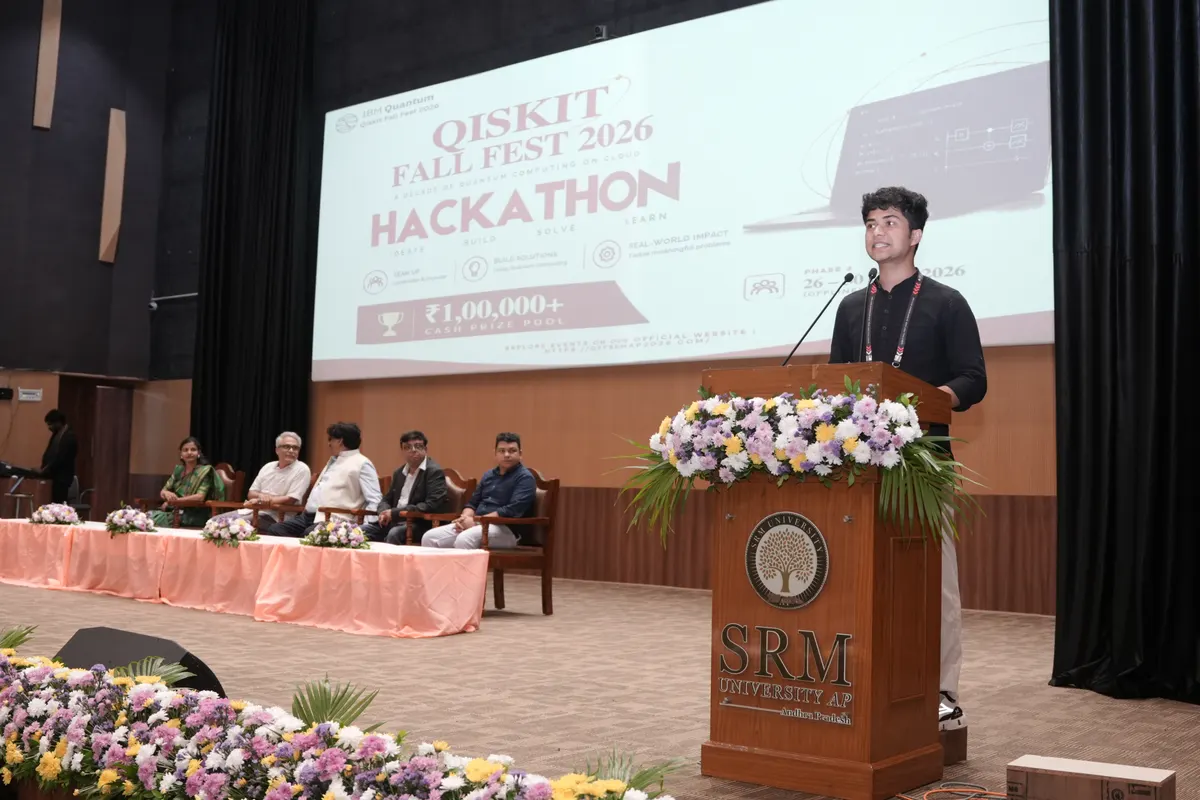
Me speaking at the hackathon session of Qiskit Fall Fest 2026, SRM University-AP.
I joined about two weeks after planning began. With the team I went through about 60 proposed
events and kept the 20 we could really run, and explained each removal. I also wrote a large part
of the festival website, built the tool that scored the hackathon entries, and taught the hands-on
Qiskit session on the first day.
The people who did the work: Baratam Praneeth Gupta led Technical Programs. Sri Vastava Sri
Harsha Gampa led the Hackathon and Competition cell and ran the hackathon. Srihaas Pigilam led
Website and Technology. Jaswanth Kumar Kondameeda built and ran the Quantum Capture the Flag
contest from start to end; I supervised him. Jyoshna Pilli ran all the offline games and trained
her team. The website's interface was mostly by Jessy Robert (Robert Bandaru), Shaik Mahaboob
Subhani, Sandeep Nambi and Pradnish Chintada. Harsha Siva Akash Saladi was the student executive
and Varsha Sambhaje (Biradar) the faculty convener.
Technical details
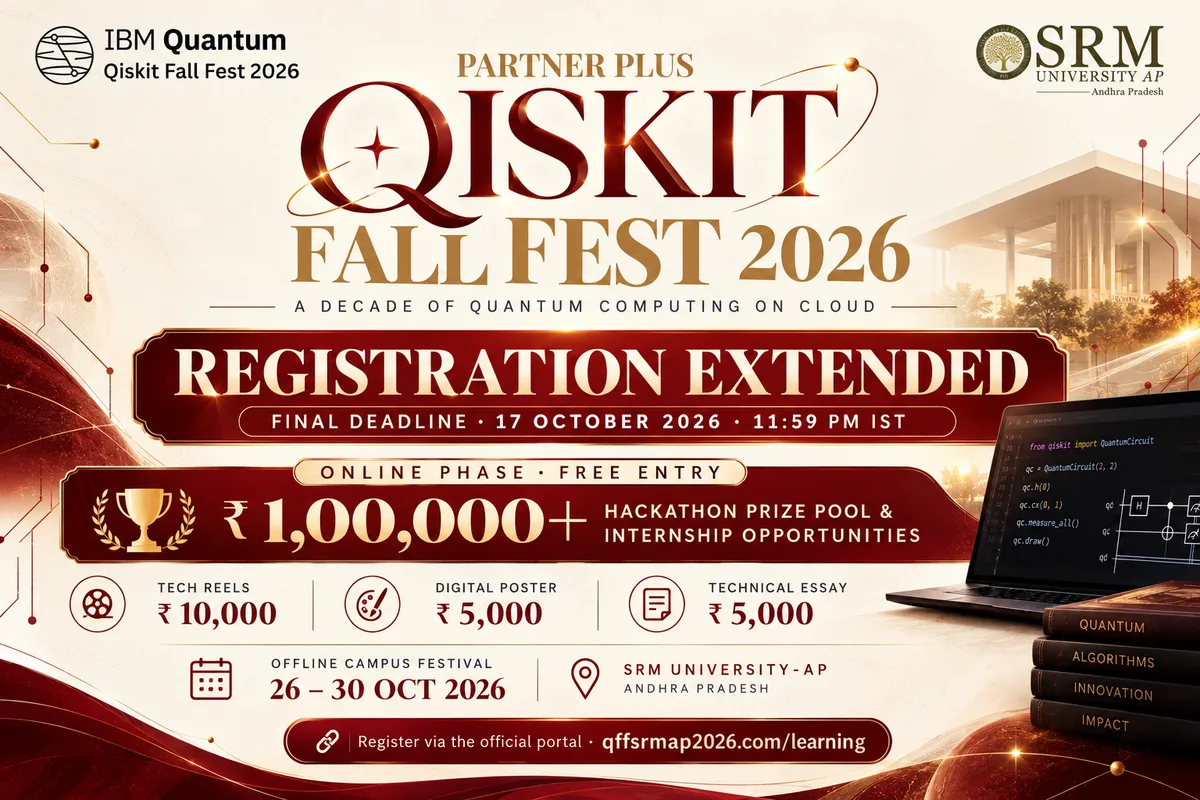
Online phase 8 to 10 Oct, offline phase 26 to 30 Oct 2026. SRM University-AP was one of 188
host universities and one of 6 "Partner Plus" hosts (figures from my article).
Festival platform (Next.js, React, TypeScript, Supabase, Vercel), a team product. 175 of
its 443 commits are mine: lectures, quizzes and certificates, the hackathon team and
submission flow, QR passes with gate verification, payments, security hardening, push
notifications and the evaluation desk.
Hackathon first-round evaluator: an automated scorer for 129 team repositories against a
100-point rubric. I fixed 11 scoring defects, then averaged the automated score, the judge
score and an independent review by 8 reviewers. The re-evaluation changed 29 decisions.
Quantum Capture the Flag: I added server-side flag checking, scoring, a machine-learning
challenge track and a results view to Jaswanth's platform.
Hands-on kit: a build pipeline that turns QWorld's Nickel notebooks into a participant and
instructor kit with one-click installers, credited to the original authors.
For scale: 2,718 registrations. The hackathon had 20 problem statements; 130 teams
submitted in the first round, and 44 teams (196 members) were present at the 24-hour finale.
Hosting students and teachers from Nepal on campus
IR Council · SRM University-AP
↓
I led the Aadigyan Winter Youth Program of the International Relations Council,
which hosted students and teachers from Nepal at our university.
Event ManagementCross-Border Program
Leadership is a skill I keep learning, much of it from the books on my
Books shelf.
"It is not enough to have a good mind. The main thing is to use it well."
— René Descartes
Projects & Hackathon
Designing superconducting qubits on a computer
Self-Project
↓
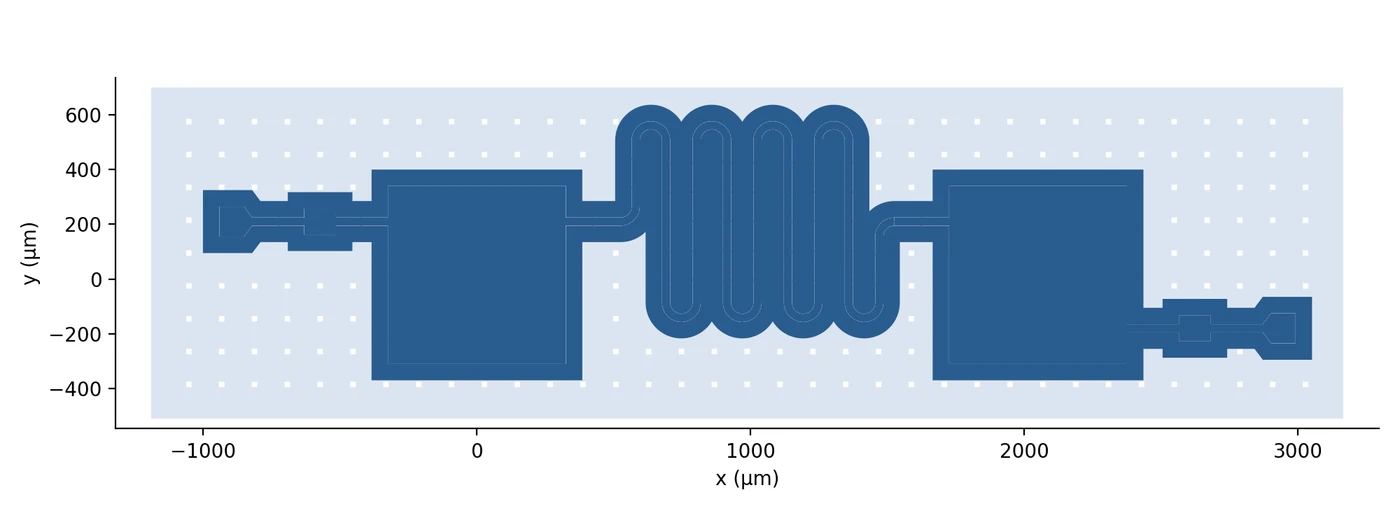
A qubit is the basic part of a quantum computer. One common kind is a tiny
superconducting circuit on a chip. I learned the software used to design these chips, drew a
single qubit and then a pair of connected qubits, and simulated how they would behave. These are
designs on a computer. Nothing has been fabricated.
My two-qubit layout, plotted from the design file: two qubits (the squares) joined by
a winding resonator. About 4.4 mm across.Technical details
Keysight ADS 2026 with QuantumPro. I followed Keysight's tutorial and then extended it.
Single transmon with a readout resonator: qubit about 6.55 GHz, anharmonicity about 361 MHz,
resonator about 8.16 GHz, dispersive shift about 7.0 MHz.
Two transmons with a bus coupler: qubits at about 6.61 and 6.72 GHz, coupling J about
6.25 MHz, shared resonator at about 8.58 GHz.
Layout exported to GDSII with 0 errors. Niobium response plotted at 300 K and 9 K.
All figures are simulation results, not measurements.
Keysight ADSQuantumProTransmonGDSII
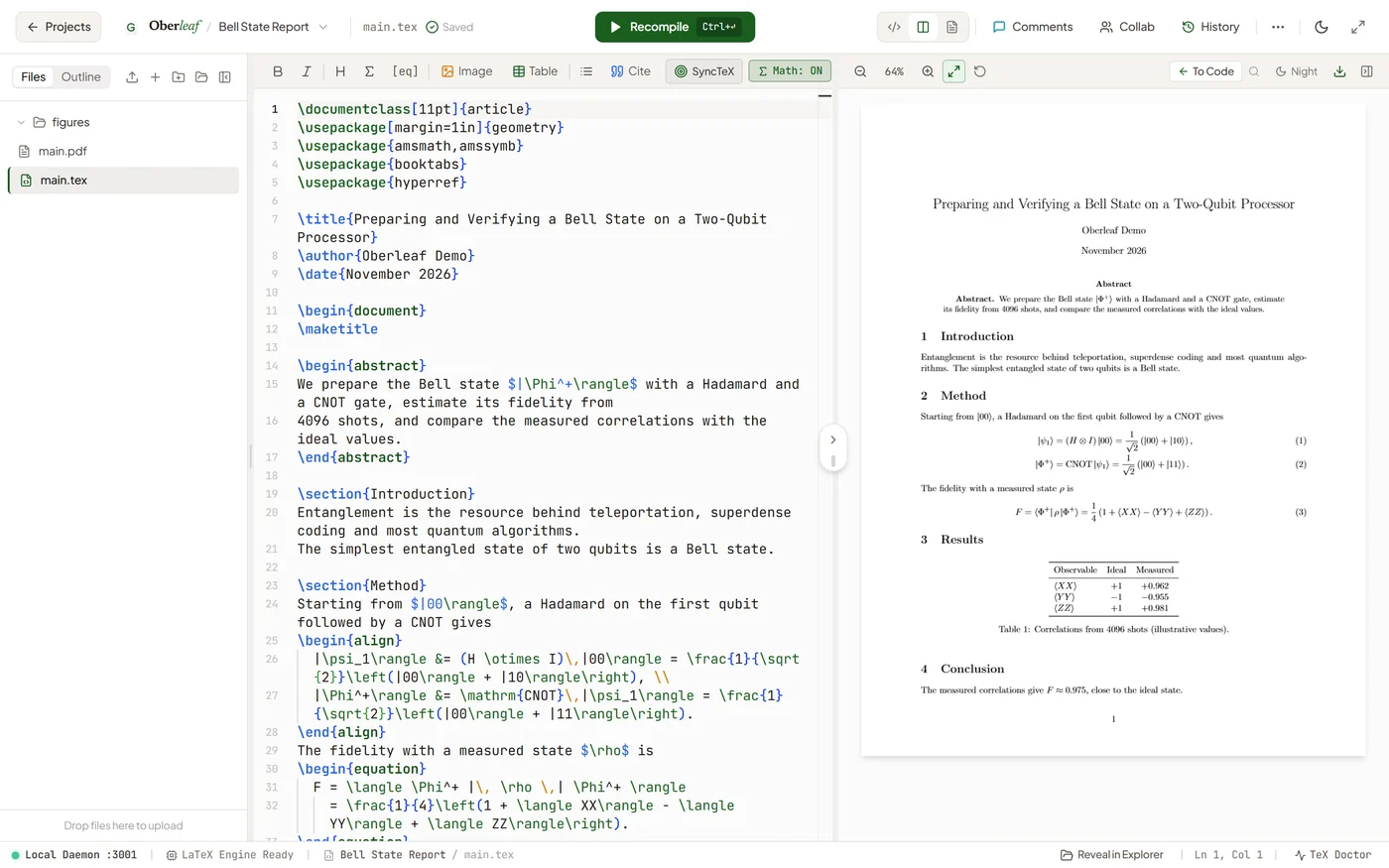
Oberleaf: a free editor for writing scientific documents on your own computer
Most scientists write papers and reports in a system called LaTeX. Online
editors put a limit on how long a document may take to build, and a long thesis can hit it.
Oberleaf does the work on your own computer, so there is no limit. When something goes wrong, it
explains the error in plain English. I write my own CV and lab reports in it.
Oberleaf: the source on the left, the finished page on the right.Technical details
Open source (MIT licence). Not affiliated with Overleaf.
Recompiles in 1.3 to 1.8 s on an i7-1165G7 laptop. Equation preview in under a millisecond
on a 10-page document.
Explains 52 common TeX and BibTeX errors, with one-click fixes for 27 of them.
Jump between source and PDF, outline, review comments, a saved checkpoint on every
compile, whole-project import from Overleaf, automatic updates.
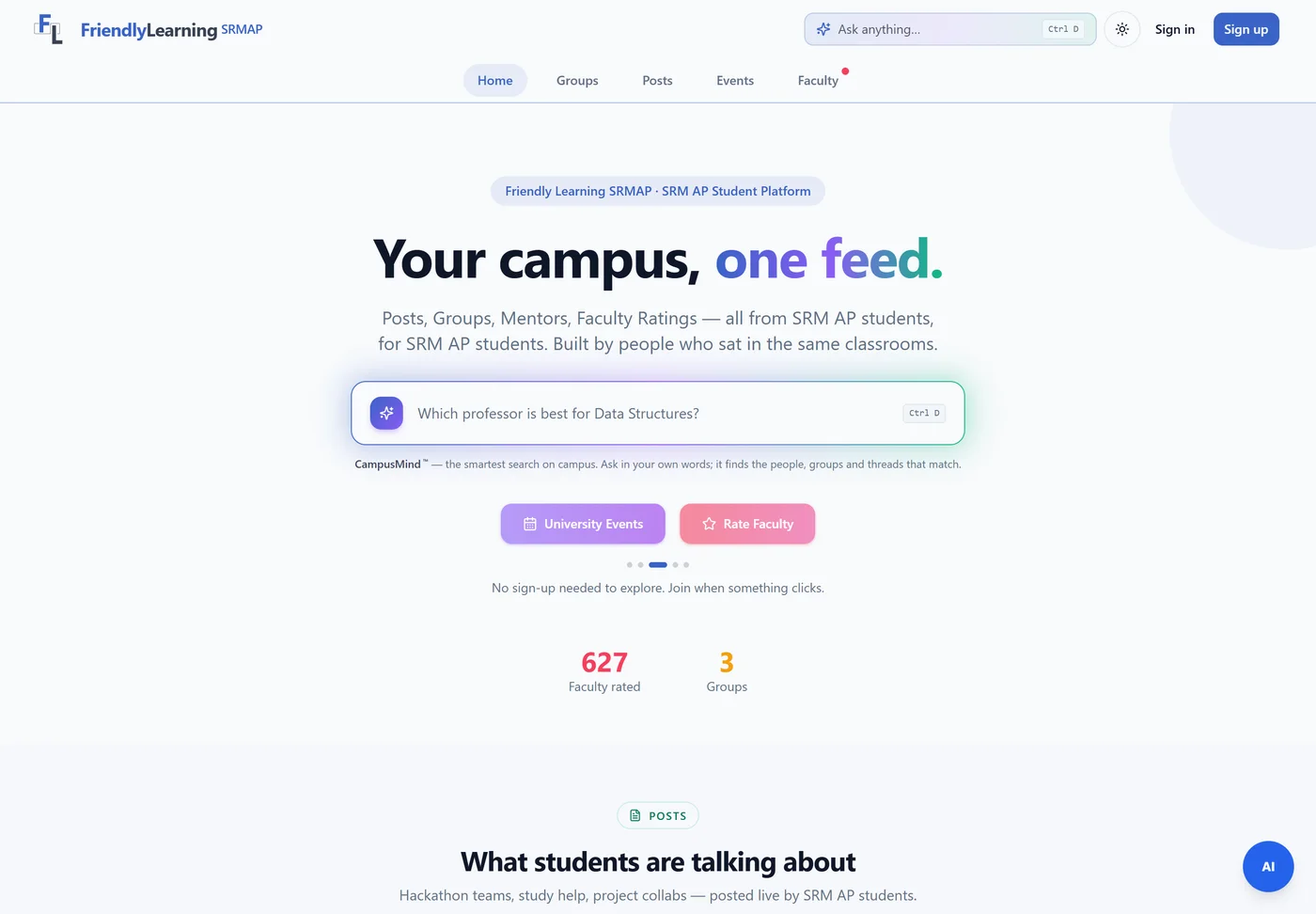
A website where students at SRM University-AP can find a senior to mentor them,
look up teachers and their research, and see events and opportunities in one place. I started it
because finding a learning partner or a hackathon partner on campus was hard. It is still small:
27 registered accounts and 4 verified mentors so far.
The Friendly Learning home page.Technical details
Peer mentorship with verifiable mentor certificates, a faculty directory with anonymous
ratings, communities, events, and attendance and timetable synced from the student portal.
Search by meaning over 624 faculty research profiles (pgvector, Gemini embeddings).
React, TypeScript, Supabase, Vercel. Automated visual checks on every page.
The first version came from the Lovable AI builder. In July 2026 I moved it to a codebase I
maintain by hand, and since then I have worked with Claude Code. Of 1,452 commits, about 960
are mine and 455 are from the Lovable bot. A few other students made small contributions.
ReactTypeScriptSupabasepgvector
Quantum Ascent: a free course from one qubit to a real quantum algorithm
A course that takes a beginner from a single qubit to a working quantum
algorithm in six steps. You can try every circuit in the browser, with nothing to install. I built
it as my entry for the WISER Education Challenge 2026.
Technical details
Six modules ending in QAOA for the Max-Cut problem.
The circuit simulator is written in JavaScript and checked against Qiskit to 1e-12, with
302 automated checks.
I invest for the long term in the Nepal stock market, and I found no good tool
to see what I had really put in, my real returns and the bonus shares I had received. So I built
one for myself. I also built a score that ranks stocks, and then tested honestly whether it
works. It did not beat the market, and I report it that way.
Technical details
Imports the Meroshare CSV. Shows live prices, gain and loss, dividends, quarterly
fundamentals and a sector ranking. A desktop app that keeps the data on your own machine.
The backtest was pre-registered: the method was written down and the scorer frozen before
any result was seen. 15 quarterly periods (Dec 2022 to Sep 2026), about 160 stocks.
Result: 13.1% a year against 13.8% for a matched benchmark. A weak positive signal in the
ranking (rank correlation 0.075 to 0.091). A live forward test has started.
ReactTypeScriptPythonpytest
Quantum
Double Shield Protocol: sharing a secret key and noticing if someone listens
Today's internet encryption depends on the fact that ordinary computers cannot
split very large numbers into their factors. A large enough quantum computer could. Our team set
out to show a way of sharing a secret key that stays safe: anyone who listens in disturbs the
signal, and can be detected.
We built it at the Amaravati Quantum Valley Hackathon, where it placed third.
Technical details
BB84 quantum key distribution combined with a quantum random number generator, simulated
in Qiskit, with eavesdropper detection by error rate.
QiskitBB84 ProtocolQRNG
Nepali
Village Calculator: working out interest the way villages do
I found no app or website to help my mom calculate interest the way it is done
in Nepali villages. She would often have to call a neighbour just to figure it out. So I built
one myself: a free calculator, in Nepali and English, that counts interest by the day on the
Nepali calendar (Bikram Sambat), made for village loans and personal lending.
I kept missing university seminars that were buried in my inbox. This script
reads my mail every day, sends me a short summary, and adds the events to my calendar.
In this course project we built a fan that turns on by itself above a set
temperature, using a simple analog circuit: one transistor and a temperature-sensitive resistor,
in a 3D-printed case. It was made to be used, not just shown, and it often comes in handy for my
labmates.
Every message we send online, a WhatsApp text, a bank transaction, an email, is
protected by encryption. Most of it relies on one simple fact: multiplying 3 × 5 = 15 is easy, but
given a number hundreds of digits long, finding the two numbers it came from is extremely hard
for an ordinary computer. In this course paper I studied how Shor's algorithm breaks that
assumption, and the new kinds of encryption being built to resist it.
"Losing is a habit. So is winning."
— The Compound Effect, Darren Hardy
How I Think
Believe in the power of compounding.
In learning, in relationships and in investing. I rise early and keep a routine, because small
things done every day add up. I invest in the Nepal stock market the same way, for the long term.
Think from fundamentals, and build it by hand.
Physics taught me to question anything in depth. I understand a thing properly only after I have
built it. When the lab's temperature controller misbehaved, I measured it, read the manual again,
and found the real cause.
A tool should explain itself.
I learned this from Don Norman's book on design. It is why Oberleaf explains errors in plain
English, and why this page starts every entry in ordinary words.
Build what does not exist yet.
Most of my projects began with something missing around me: a calculator my mom could use for
village loans, a place for students on my campus to find a mentor.
Give credit by name.
Almost nothing here was done alone. I try to name the people who did the work, as I did in my
article on Qiskit Fall Fest.
In the long run I want to build a business that funds scientists, and to
bring quantum technology to Nepal.
Education & Certifications
B.Sc. Physics (Honours with Research)
Department of Physics, SRM University-AP · Aug 2023 – May 2027 (expected)
Thesis supervisor: Dr. Krishna Prasad Maity. Dean's List and an 80% merit scholarship. My seventh
semester is a six-month internship, January to June 2027.
Before that: +2 at Global School of Science, Kathmandu, and school at Lord Bright Wisdom School,
Sarlahi. I am from Mahottari, Nepal.
QuantaRiSE Quantum Winter Fellowship (selected). QMD Hub, Plaksha University
UG/PG SEED Grant, SRM University-AP, for the chromium-doped cadmium selenide study
WISER Quantum Algorithm and Hands-on Training, on a full scholarship
Third place, Amaravati Quantum Valley Hackathon
WISER Summer Program 2026: What is the future of optimization? Classical + AI + Quantum
The Washington Institute for STEM, Entrepreneurship & Research
"Everything you need is already within you."
— Hermann Hesse, Siddhartha
I grew up in a small village in Nepal. As a quiet kid, my mind was always racing with ideas: trying to
extract soap back out of foam, attempting to build hot air balloons from plastic bags I had seen in
movies, and tinkering with electronics (which usually just resulted in me getting shocked). But that
raw curiosity led me to physics, and physics led me to labs, instruments, and a deep belief that
science should serve people.
I am currently a fourth-year undergraduate Physics student at SRM University-AP. My work sits at the
intersection of experimental solid-state physics and quantum technology. By degree I am a physicist,
because it helps me to think from fundamentals. Physics knowledge helps me to think and question
anything, philosophy, business, investment, in depth. I have a goal of making human life easier via
technology accessible to the general public.
I am a long-term investor who believes in quantum technology, green energy and electric vehicles. I
love building things with my own hands. I like reading books related to business and human-centric
approaches. I read books to give myself a different view to look at the world (Inner Engineering,
Siddhartha, The Alchemist, The Untethered Soul, The Peaceful Warrior...).
I am a tech guy who loves technology, and someone who likes to spend time in solitude to think and
talk to nature. My aim is to make my country Nepal equipped with tech.


 Portfolio
Insight: a private tracker for investors in the Nepal stock market
 A
helper that reads my email and puts events on my calendar
 A
fan that switches itself on when it gets hot